Showing posts with label feminism. Show all posts

Monday, August 3, 2020

August sun

A moment from last year, from a land dedicated for the past 47 years to women.

Bare skin, hot sun, blue
sky, surrounded by
(no walls)
open meadow, trees
the snow-capped mountain
to the east, snatches of women's talking
and singing.
I didn't mind, for the first time,
the shower's cold.
No hollering or hurrying
needed for me to bear it,
warm as I was
from the work of packing up camp
under the midday sun --
conscious as I was of
the nearness of farewells

I wanted to leave that land with traces
of her water on my skin
still, in my drying hair.
I scrubbed myself to a glisten in
that warm sun, that soft breeze
with oil and sugar (gifts left by another woman)
assiduously
meticulously
feeling something of a ritual in it
feeling the air and the sun and the land all
intent on me, and
I intent on them.

All tumble of apples
wind bells
high yellow grass
and laughter.

Monday, January 27, 2020

Thoughts after a man throws an open drink out of his car at me

Untitled

• Wow, people really hate women. And cyclists.

• Dear self, blessed be the fruit of your decade-plus of practice being an uppity nasty woman, i.e. your quick mouth and quick middle finger,

• (Is he going to get out of his car and try to fight me?)

• Random man, your inability to hit a moving target from a moving car is a sign from above that heaven and nature did not design you for persecuting strange women exercising their freedom of speech and movement, and you should Stop.

• Isn't it silly that women ever use the word "bitch" against other women?

• Isn't it silly that I spend any time at all thinking about whether or not to do things that bring me enjoyment, peace, or wellness? I feel motivated and almost delighted by the clear passion of another for my unhappiness. My inner contrarian is never stronger than in these moments.

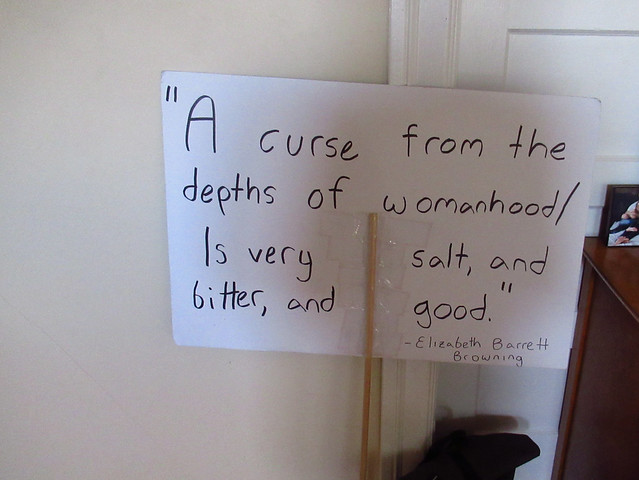
I'm including photos of my Women's March sign, because relevant. I added the quote on the back hastily this year while en route to the march; you can read the full poem it comes from here.

Untitled

Wednesday, January 29, 2014

Womyn's Land

IMG_0025
IMG_0022
IMG_0024
IMG_0019
IMG_0020
IMG_0016
IMG_0017
IMG_0018

November 2013, Northern California. I tagged along with a new friend and her girlfriend on a three-hour drive north, to a small rural lesbian community that has been in existence since the '70s. It was deeply quiet there — one of those places where I notice how noisy my ordinary life is because all of a sudden that noise is just gone.

The pond was too cold even for just my feet, but if I'd wanted to go swimming, I could have. No swimsuit, but I could have just taken off my clothes and jumped in. Maybe come summer. Doors remain unlocked, and you can fall asleep alone in the grass without worrying about your safety or possessions.

My friend had to point that out to me when I said I was sleepy; it didn't occur to me. I was reminded of what Sylvia Plath, nineteen years old, wrote in her diary about the "awful tragedy...[of being born a woman]":
...all is spoiled by the fact that I am a girl, a female always in danger of assault and battery....I want to be able to sleep in an open field, to travel west, to walk freely at night...
That awareness of the constant potential for danger that comes with being a woman in a violent patriarchal world, that is a kind of psychic noise too. And again, it's easy not to notice how it wears on you until you feel what an afternoon is like without that. And that quiet is almost bewildering...

I am carrying that afternoon with me. That taste of freedom, and the conviction that by rights I should have that freedom anywhere.

I am trying to imagine who I would be if my safety and privacy were always so inviolate.

Thursday, May 2, 2013

Read in April 2013

Titles link to the pertinent Goodreads page — feel free to add me as a friend.

1. Woman and Nature: The Roaring Inside Her, by Susan Griffin

2. Blessing the Boats: New and Selected Poems, 1988-2000, by Lucille Clifton

3. The Beautiful: Collected Poems, by Michelle Tea

4. Fun Home, by Allison Bechdel

5. Harry Potter and the Goblet of Fire, by J.K. Rowling (reread)

Friday, February 8, 2013

"It is better to speak..."

I'm posting this today for courage, for me, for you. Have a lovely weekend, my dear friends. Do something strong with it.

A Litany for Survival

For those of us who live at the shoreline
standing upon the constant edges of decision
crucial and alone
for those of us who cannot indulge
the passing dreams of choice
who love in doorways coming and going
in the hours between dawns
looking inward and outward
at once before and after
seeking a now that can breed
futures
like bread in our children's mouths
so their dreams will not reflect
the death of ours:

For those of us
who were imprinted with fear
like a faint line in the center of our foreheads
learning to be afraid with our mother's milk
for by this weapon
this illusion of some safety to be found
the heavy-footed hoped to silence us
For all of us
this instant and this triumph
We were never meant to survive.

And when the sun rises we are afraid
it might not remain
when the sun sets we are afraid
it might not rise in the morning
when our stomachs are full we are afraid
of indigestion
when our stomachs are empty we are afraid
we may never eat again
when we are loved we are afraid
love will vanish
when we are alone we are afraid
love will never return
and when we speak
we are afraid our words will not be heard
nor welcomed
but when we are silent
we are still afraid

So it is better to speak
remembering
we were never meant to survive

– Audre Lorde

Sunday, August 12, 2012

Read in June 2012

1. Graceling, by Kristin Cashore
An enjoyable one-night read. Reminded me of the young adult fantasies I loved in middle and high school.

2. True Love: A Practice for Awakening the Heart, by Thich Nhat Hanh
Succinct reflections on mindfulness and love, from a Zen perspective. A beautiful little volume.

3. Pornland: How Porn Has Hijacked Our Sexuality, by Gail Dines
A feminist sociological account of the modern porn industry. She traces its history, beginning with the nude magazines of the fifties, to explain how it came to its current internet-based, multi-billion-dollar form. Her descriptions of the brutality of today's porn — the blatant misogyny and racism, as well as the sexualization of children via "pseudo-child" or "teen" porn — are highly disturbing, but crucial to her discussion of how porn affects its viewers and society at large.

4. Nativity Poems, by Joseph Brodsky
Of the multiple translators who put these poems into English, I certainly prefer the style of some over others (things like how they preserved rhyme and meter, etc.). The poems of his younger Christmases were more compelling and beautiful to me, but I can't remember much else beyond a few passages that glow in my memory.

5. Mastiff, by Tamora Pierce
Not up to her usual standards, e.g. the twist did not work for me, but still enjoyable for nostalgia's sake. Oh, and the romantic interest is too perfect, by which I mean, actually too perfect.

6. There Is Nothing Wrong with You: Going Beyond Self-Hate, by Cheri Huber
Deep and deeply useful, accessible insights. More Zen.

7. The Terrible Girls, by Rebecca Brown
There is an odd flavor to these short stories, at times evocative and profound (re-readable to be sure), at times dry and head-scratching strange. The prose is definitely not the main dish here. And the subtle connections between the stories are genius to me.

8. From Housewife to Heretic, by Sonia Johnson
The memoir of a second-wave feminist excommunicated from the LDS church for her pro-ERA activism. She is a likable, engaging narrator; her passion and down-to-earth-ness are infectious and her story is compelling. I'm looking forward to reading her later works.

9. The Hunger Games, by Suzanne Collins
This was a happy complement to the movie, which I very much enjoyed. Another one-night read — just as fast and gripping as I'd heard it was.

10. Translation is a Love Affair, by Jacques Poulin
A small novel, vivid and refreshing to taste. I like the narrator-protagonist a lot. I like the book for its wisdom in what it does not attempt as well as for its success is just being lovely and pleasant.

Thursday, July 26, 2012

How I deal with street harassment

My modus operandi used to be just continuing on my way as I boiled with humiliation, anger, fear, and helplessness.

Until last summer, when I had a job that 1) gave me a lot of practice talking to strangers, and 2) was located just off a plaza where a number of verbally aggressive homeless men congregated.

I got fed up with the harassment and started talking back.

What helped me make a habit of responding: Thinking of one or two comebacks flexible enough that I wouldn't have to improvise. And plenty of dudes willing to "help me" "practice."

My standbys are:
  • "That's actually NOT my name."
  • "Did I ask for your opinion?"
  • "Excuse me?"
Add some righteous indignation and laser eyes, and you're set.* Useful on public transit as well as with panhandlers or fellow pedestrians.

When it comes to Jerks in Cars, there is not much time, so my repertoire is limited to gestures like the finger. Depending on proximity, speed of traffic, and how much berserker you have in you, you may have the option of assaulting the vehicle in question. (Speaking as a mere kicker of bumpers and banger of hoods, the dudes hate having to admit that their chariot of misogyny is not untouchable.)

Not surprisingly, coming back at a harasser is much easier in some circumstances than in others. Homeless men don't particularly intimidate me.** An young, expensively dressed man, a big man, a large group of men — any of these would generally be more intimidating me. Depending on my survival radar, I might decide it's not worth it. That's fine. (The point of talking back is not that you are a weak person if you don't.)

Respect for intuition/survival radar withstanding, no harasser has yet responded to me in a way that outweighed the satisfaction of talking back.

The point is: that you are allowed to be angry at men who try to degrade you, and you don't have to swallow that anger. That it is not your job to be pleasant and submissive. It is not your job to treat harassers as if they are not doing a terrible, shocking, unacceptable thing. Feeling helpless sucks, and claiming your right to act like what you are — a human being with reasonable rights and emotions and the means to express both  — is cathartic and constructive.

*Laser eyes can work pretty well preemptively too, if you're getting warning vibes from someone's demeanor.
**Almost all of the men who harass me are panhandlers or otherwise visibly homeless. Somewhere in the overlap of race and class with sexism and this being San Francisco, there is an answer to this. I have an inkling that harassment in public places generally takes place across boundaries of race and class, and that men harassing or assaulting women of their own class and particularly race are more likely to do so in private.

Thursday, July 5, 2012

To keep warm through the night

What a language it is, the laughter of women,
high-flying and subversive.
Long before law and scripture
we heard the laughter, we understood freedom.

- Lisel Mueller

I can't tell you what it meant to be breathless with laughter with my princess-haired friend without telling you that twenty minutes before she was speaking of her dear friend whose boyfriend is regularly beating her up, and how she suspects they are going to get engaged soon.

I can't tell you about joy, about one of the songs we sang along to, in between cracking up at how the bass made my parents' minivan rattle — far from home, all alone/but we're so happy — without saying also that I wore my throat raw sobbing to the empty space of the car on my way home. (What can/could I do? What is there to do?...)

No, the weight of the laughter that I share with my friends is some function of this litany of pain. The assaults, the abuse, the depression and eating disorders, the scars literal and figurative, all these grievances that I find so uniformly distributed among the women I love. It's not incongruous that we laugh. And it's this honesty that allows it. It is possible to really laugh because we trust each other, and that includes not having to pretend we do not know all these reasons not to laugh.

Despite all this, all these things that so often come with being a woman in this society, we still have laughter. We do. And it is not escape, denial, or forgetting, but the taste of the bitter with the sweet, sweeter for its being so dearly bought. It is the insolence of being joyful with open eyes — and it is our honor, to speak so bold a language. Our fire that we are burning through the night.

Tuesday, June 19, 2012

Read in May 2012

As always, titles link to the pertinent Goodreads page — feel free to add me as a friend on there if you have an account.

1. X-Day, Vols. 1 & 2, by Setona Mizushiro
Manga about a motley group of outsiders that unites around a desire to blow their high school up. Yes, it's dark and it's about nihilistic people; it's also quite poignant. It didn't even matter that I didn't care that much about the plot; I cared enough about the premise and the narrator.

2. Imagine Being More Afraid of Freedom Than Slavery: Poems, by Pamela Sneed
I'm somewhat indifferent to her style, but her thought processes feel like my own, and that's comforting, and illuminating in some ways. Poems of memoir, of varying degrees of politicality.

3. Be the Person You Want to Find: Relationship and Self-Discovery, by Cheri Huber
This is a lot more Zen/mindfulness philosophy than it is normal self-improvement/self-help. It's good. She's compelling and explains well, and the formatting (i.e. the amount of empty page space) suits the content.

4. The Death Notebooks, by Anne Sexton
Image-driven, wandering, morbid. The sequence called "The Furies" is gorgeous.

5. Sexism and God-Talk: Toward a Feminist Theology, by Rosemary Radford Ruether
This was such excellent food for my intellect. As it says, it is not a feminist theology; it is a contribution towards a feminist theology, in the form of assessments of and reflections on other Christian theologies and theological positions. She is bold, not always orthodox but eminently reasonable, very consistent, utterly penetrating... I kind of fell in love her writing and her thinking — she has a gift for synthesis and for articulating thorny things in spacious ways.

Friday, May 25, 2012

Read in April 2012

As always, titles link to the pertinent Goodreads page — feel free to add me as a friend on there if you have a Goodreads account.

1. A Prayerbook for Spiritual Friends, by Madeleine L'Engle and Luci Shaw
I liked this more as a portrayal of the friendship of these two women — both writers and poets, in the later part of their life — than as a devotional work. As the latter, it's nice, but pretty light.

2. The Passion, by Jeanette Winterson
Ambivalent. If you've read this, I'd be interested to hear what you thought.

3. Woman Hating, by Andrea Dworkin [free download]
Strong, compelling, clean analysis. The opening section on fairy tales was particularly brilliant. I felt a little skeptical about the claims and declarations she makes in the last twenty or thirty pages, though.

4. The Rosary for Episcopalians/Anglicans, by Thomas Schultz
Good basic primer, with some alternative rosaries to pray, e.g. one inspired by St. Julian of Norwich's Revelations of Divine Love.

5. The Book of Folly, by Anne Sexton
I don't remember. But I like her, and I finished it, so it couldn't have been worse than "pretty good."

6. The Fault in Our Stars, by John Green
Also ambivalent to this one, at least to the plot. The characters were realistic, quirky, and rather dear. I thought his portrayal of the subculture that arises among seriously ill children and teens was so interesting: the frequent experience of "cancer perks," doubts about the way cancer victims are made into saints, doubts about the meaning ascribed to their young lives because of their illnesses.

7.  Eight1011, by Sui Solitaire [Pay as you can here]
A polished, atmospheric collection of semi-/quasi-confessional poems. Somewhat dark, with an absorbing flow.

8. The Goose Girl, by Shannon Hale
Reread. Always gorgeous (a retold fairy tale). I was particularly struck this time by how cinematic the imagery was.

9. The Depression Book, by Cheri Huber
This Zen/mindfulness (a.k.a. tangerine-eating) perspective has significantly altered my own perspective on coping with depression, for the better, I think. Her approach to depression and other negative emotional experiences is unconventional but empowering, and pretty darn functional. If you deal with depression or anxiety, I highly recommend this.

Tuesday, May 15, 2012

Consciousness

The waters of my brain are too murky lately to write easily to anyone but myself.

I'm still very young, but the world seems to have darkened significantly over the past several years as my understanding of it has grown.

I still believe that to see truly is the heart of all mercies. That seeing is where hope and possibility begin. First comes the clarity of sight — then hope. But there's pain between, in the space of gaining clarity.

And my body is so heavy from the pain of this work lately. I do not want to see any more  —  this society is terrible, I get it, and now there is so little left for me to stand on. I trust that with greater understanding, though, hope will return. Like second simplicity. Second hope.

So I am saying every day to myself, Do not run. Wider. Open your eyes.

Monday, April 23, 2012

Male dominance is a continuum

I learned that a professor from my alma mater has been charged with possession of child pornography.

Two of my college friends and I were visiting. That same weekend, we were sitting down with homemade drinks to read aloud from some ultra-conservative Christian books on gender and marriage — for a laugh, you know, because we were all raised in conservative evangelical Christianity and came to feminism together.

One of us brought up the child porn scandal again. I forget who. And it reminded me very suddenly that the books we were passing around were not harmless.

By the way...to be more precise: it was aggravated child pornography. I had to look that up — it means the victimized children were under the age of thirteen. According to the news coverage, many of them "appeared" to be younger than five.

So: There are men who take pleasure, in the plainest sense, in materials that document the rape of small children. Many of them, apparently. And most of them aren't psychopaths living in their mothers' basements; some of them are model Christian men who teach child development classes at Christian colleges.

And here we have these books about how women need to suppress their opinions more and obey their husbands more and learn to be happy with what men want. Yeah. Male dominance is a continuum, and all of it is ghastly once you've seen it as such, seen the extremes and made the connections. (And the extremes are so common! So common!) It's a dead serious matter when millions of my fellow Christians wholeheartedly believe that men need more power. All these horrors, crimes of dehumanization and dominance, perpetrated almost exclusively by men, and yet here are all these ordinary people saying, men need more power, women and children aren't submitting enough...

No. No.

I do not believe the rape of children for male entertainment will end until men as a class lose a great deal of their power, because men as a class hold a number of powers that women are not permitted to have, as well as a number of powers that no one should be permitted to have.

Patriarchy is a continuum.

Courage: we must make the connections, now.

Saturday, March 24, 2012

These are the materials

[trigger warning: abuse]

I don't want to hear how he beat her after the earthquake,
tore up her writing, threw the kerosene
lantern into her face waiting
like an unbearable mirror of his own.    I don't
want to hear how she finally ran from the trailer
how he tore the keys from her hands, jumped into the truck
and backed it into her.    I don't want to think
how her guesses betrayed her — that he meant well, that she
was really the stronger and ought not to leave him
to his own apparent devastation.    I don't want to know
wreckage, dreck and waste, but these are the materials
and so are the slow lift of the moon's belly
over wreckage, dreck, and waste, wild treefrogs calling in
another season, light and music still pouring over
our fissured, cracked terrain.

– Adrienne Rich
from "An Atlas of the Difficult World"

Wednesday, March 14, 2012

Possibility and the stories we're not "supposed" to have

I weigh something like thirty pounds more than I did two years ago, the most I have ever weighed, and that's supposed to really distress me, but I have to say, it doesn't.

The bullshit consumer-capitalist/patriarchal messages about why I should be distressed, they make me anxious on occasion. But when I maintain awareness of those messages as external (imposed), I realize that I do not have strong feelings about the size of my body.

I also do not have any sob story about "letting myself go," or not feeling like myself anymore, or not respecting myself, or how I've been just existing, not really living, or any of that nonsense that we're supposed to talk about when we talk about gaining weight.

On the contrary, I feel wiser and more creative than I ever have before — intellectually, artistically — and there is so much vigor in my days. I have never felt so awake in my life.

There is such a poor selection of narratives to choose from when we look at the cultural canon, and not just when we're talking about weight gain. The narratives that we have needed have been withheld from us on the grounds that they would not be useful for selling things to us.

It's quite important that, as we are seeking the shapes of our lives, we do not settle for these pre-fab stories. They are easier, but they do not satisfy. The only stories that can do justice to our lives are the ones we ourselves are doing the hard work of discerning. The honorable truths. Truths whose existence affirm the wideness of what is possible.

And my truth today is that I gained weight, and it was not a fall from grace. I gained weight, and it means little more to me than that I weigh more and take up more space than I did before.

The gap between what our experiences and histories "should have been" and what they actually are — just like the gap between what we ourselves "should" be and what we actually are — is a manufactured illusion. Only what has happened has happened; only what is, is.

The art is in seeing what is, as reality in its own right, instead of merely in relation and subordination to what "ought" to have been. And the art is in the way that discerning and speaking our realities, "allowed" or not, opens reality up wider for others too.

Monday, March 12, 2012

Read in February 2012

1. At the Root of this Longing: Reconciling a Spiritual Hunger and a Feminist Thirst, by Carol Lee Flinders
Much food for thought about the conflicts between religion and feminism, and the possibilities for complementarity. The author is a member of a meditation community; her focus is, fittingly, more on mystic traditions than on the mainstream of any religion. Though the book is only a few years old, I'd call her a second-wave feminist. Lisa's review is good. I learned a lot and my thinking was VERY stimulated.

2. Life is Funny, by E.R. Frank
The intersecting lives of teenagers in and around New York City. Gritty, but not all sad. The author is a social worker — when I read that in her bio, I went, "Ah..." and nodded. It's a quick read with a heart.

3. The Gate to Women's Country, by Sheri S. Tepper
Post-apocalyptic ecofeminist sci-fi. The world-building reminded me of Tamora Pierce's novels. Some might find the beginning slow, but stick with it. I got very emotionally involved with this book. It passes quite a (deserved, in my opinion) indictment on modern post-/industrial societies, and it's zang good.

Friday, February 17, 2012

Read in January 2012

1. The Thing About Thin: Body Image, Eating Disorders, Resistance, + What Really Matters, by Sui Solitaire
[See this post.]

2. Girl Meets God: A Memoir, by Lauren F. Winner
Her style of writing is so plain that this book didn't captivate me at first, but by the end I loved it. It's about her conversion to orthodox Judaism after a Jewish upbringing, and then her conversion to Christianity during college. She's so smart. Funny at times, and very self-aware.

3. Beyond God the Father: Toward a Philosophy of Women's Liberation, by Mary Daly
Deeply thought-provoking. She begins from the assumption that theology itself, and the Church itself, are corrupted by misogyny not only in form but also in principle. From there, she makes a full critique and describes her vision of a way forward, out of patriarchal religion.

4. The Lover, by Marguerite Duras
The story is absolutely messed up, and it was hard for me to stop thinking about that. The prose is kind of stream-of-consciousness. It's sad. It's not beautiful, though the atmosphere it builds is rather beautiful.

5. Jacob Have I Loved, by Katherine Paterson
A reread.

6. All My Pretty Ones, by Anne Sexton
Wonderful. Anne Sexton is becoming another favorite poet. I posted the opening poem from this collection several years ago: "The Truth the Dead Know."

Sunday, February 5, 2012

On the process of exercising our own voices

"...[T]he same thing happened to me that has happened to many other women who've set out initially to recover lost and silenced feminine voices. Too constrained or timid or plain bewildered to speak for ourselves, unready, perhaps, to open certain doors in our own consciousness, we take the part of another...and break her silence. It might be our mother or grandmother, a woman of our own ethnic background or religious tradition, or one who has undergone a significant experience that we have, too, like illness, divorce, conversion, or exile. We choose our alter egos carefully and practice ventriloquism under the guise of scholarship or journalism, and eventually, often before we realize what's happening, we've begun to exercise our own voices."

– Carol Lee Flinders
At the Root of this Longing: Reconciling a Spiritual Hunger and a Feminist Thirst

This rings true for me. For you?

I thought first of Faith's recent post on sexual harassment and fear, because she expresses anger on behalf of her younger sister in it — though I don't want to impose Carol Lee Flinders' analysis on her.

The incident that comes to mind from my own life: the sadness and anger I felt when I overheard my younger cousins assessing their bodies with the most ancient-sounding of sighs. Before I could recognize my own eating disorder as outrageous and grievous, before I could want health and peace for myself, I had to want it for them. And so I spoke about them, and a year later was ready to repeat my sentiments on my own behalf as well.

It is beautiful and right to become angry for others and advocate for them. And it is most beautiful and most right when it reminds us to expect and demand no less for ourselves — because it is consistent, because justice belongs to everyone, because we deserve no less than anyone else does. No less.

Saturday, January 28, 2012

Your surrender is significant: reprise

Sui asked me for permission to republish an older post of mine on her site, Cynosure. I admire her and her work has tremendous resonance for me, so of course I agreed and took the opportunity to revise the post accordingly.

She also (a surprise and an added honor) took a series of fantastic self-portraits to accompany it.

You can read the updated version with the accompanying images here.

Friday, December 16, 2011

Read in November 2011

1. Dear Germany: Eine Amerikanerin in Deutschland, by Carol Kloeppel
"An American in Germany." Meh eh. I don't really like her voice; it has a (culturally) patronizing tone.

2. The Tempest, by William Shakespeare
Recommendations as to what recording of it to watch now, anyone?

3. Beauty Queens, by Libba Bray
Definitely froth. (Liberal USian) Feminist revenge fantasy? Some of it's kind of profound, some of it's eye-roll-inducing. On a micro level, the voice reminds me more of Meg Cabot more than of the Great and Terrible Beauty trilogy.